Memory Foam vs. Hybrid Mattresses: Which One Is Right for You?

Buying a new mattress can feel confusing because many brands use similar words to describe comfort, support, cooling, and pressure relief. Two of the most common mattress types shoppers compare are memory foam mattresses and hybrid mattresses.
Both can offer a comfortable night’s sleep, but they feel different. Memory foam is known for contouring comfort and pressure relief, while hybrid mattresses combine foam layers with coils for more bounce, airflow, and support.
The right choice depends on how you sleep, whether you share the bed, how much support you need, and whether you prefer a hugging or more lifted feel. Understanding the difference between memory foam and hybrid mattresses can help you choose a bed that matches your body, comfort style, and sleep needs.
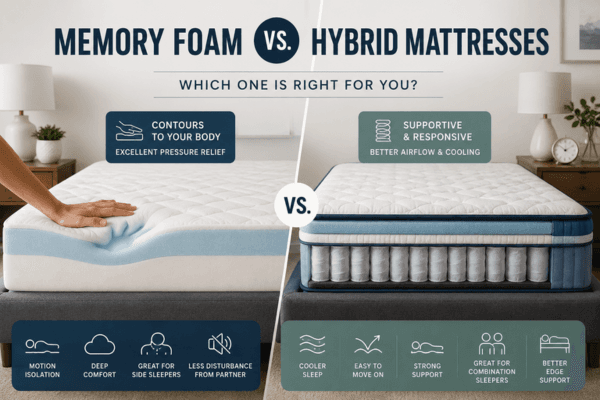
Memory Foam vs. Hybrid Mattresses: Quick Comparison
| Feature | Memory Foam Mattress | Hybrid Mattress |
|---|---|---|
| Overall Feel | Soft, contouring, and body-hugging | Balanced, supportive, and responsive |
| Support | Good support from foam layers | Stronger support from coils and foam |
| Pressure Relief | Excellent for shoulders, hips, and joints | Good, depending on foam comfort layers |
| Cooling | Can sleep warmer unless it has cooling features | Usually more breathable because of coil airflow |
| Motion Isolation | Great for reducing movement transfer | Good, but may have more bounce |
| Edge Support | May be weaker on softer foam models | Usually stronger with reinforced coils |
| Ease of Movement | Can feel slower to move on | Easier to move and change positions |
| Best For | Side sleepers, couples, and pressure relief | Back sleepers, hot sleepers, and combination sleepers |
| Common Feel | Hugging and cushioned | Lifted and supportive |
| Price Range | Often more budget-friendly | Often higher due to coil construction |
What Is a Memory Foam Mattress?
A memory foam mattress is made with layers of foam designed to contour around the body. The top comfort layers usually respond to body heat and pressure, helping the mattress adjust to your shape as you lie down.
This type of mattress is popular because it can create a soft, cushioned feel. Instead of feeling like you are sleeping “on top” of the mattress, memory foam often gives a gentle “hugging” sensation.
Memory foam mattresses are commonly chosen by people who want pressure relief around the shoulders, hips, and back. They can also be useful for couples because foam tends to absorb movement well. If one person changes positions or gets out of bed, the other person may feel less motion on their side.
However, some memory foam mattresses may feel warmer than other mattress types. Traditional dense foam can trap heat, although many newer models include cooling covers, gel-infused foam, or breathable materials to help reduce heat buildup.
What Is a Hybrid Mattress?
A hybrid mattress combines foam comfort layers with an innerspring or pocketed coil support system. The top layers may include memory foam, polyfoam, latex, or cooling materials, while the base uses coils to provide structure, bounce, and support.
Hybrid mattresses are designed to offer the benefits of both foam and spring mattresses. The foam layers provide cushioning and pressure relief, while the coils help keep the body supported and lifted.
Many sleepers like hybrid mattresses because they feel more responsive than all-foam beds. It is usually easier to move around, change positions, and get out of bed on a hybrid mattress. The coil system can also improve airflow, which may help hot sleepers feel more comfortable.
Hybrid mattresses can work well for a wide range of sleep styles, especially back sleepers, combination sleepers, couples, and people who want stronger support without giving up comfort.
Comfort and Feel
The biggest difference between memory foam and hybrid mattresses is how they feel.
A memory foam mattress usually feels more contouring. It molds closely to the body and may create a slower-moving comfort feel. This can be helpful for sleepers who like deep cushioning or want pressure relief around sensitive areas.
A hybrid mattress often feels more lifted and responsive. The coils add bounce and prevent the body from sinking too deeply. This can be better for people who dislike the feeling of being stuck in the mattress.
If you want a mattress that hugs your body and cushions pressure points, memory foam may be the better choice. If you want comfort with more bounce, airflow, and support, a hybrid mattress may feel better.
Support and Spinal Alignment
Support is one of the most important parts of choosing a mattress. A supportive mattress helps keep the spine in a natural position while you sleep.
Memory foam can provide good support, especially when it has a strong base layer. However, softer memory foam mattresses may allow some sleepers to sink too much, especially around the hips and lower back.
Hybrid mattresses often provide stronger support because of their coil systems. Pocketed coils can help distribute body weight and keep the mattress stable. Some hybrid mattresses also include zoned support, where certain areas are reinforced to support the lower back or hips.
Back sleepers and stomach sleepers may prefer hybrids because they tend to offer more lift. Side sleepers may enjoy either type, depending on how much pressure relief and cushioning they need.
Pressure Relief
Pressure relief is especially important for side sleepers. When you sleep on your side, your shoulders and hips press more directly into the mattress. If the mattress is too firm or does not cushion those areas, you may wake up feeling sore.
Memory foam is often strong in this area because it contours closely to the body. It can help spread pressure across the mattress surface instead of letting it build in one spot.
Hybrid mattresses can also provide pressure relief, but the feel depends on the comfort layers. A hybrid with thick foam layers may feel plush and contouring, while a firmer hybrid may feel more supportive than cushioned.
For deep pressure relief, memory foam may be better. For pressure relief with stronger support and bounce, a hybrid mattress may be the better match.
Cooling and Breathability
Hot sleepers should pay close attention to mattress materials.
Memory foam has a reputation for sleeping warm because traditional foam can hold body heat. Many brands now use cooling gel foam, breathable covers, copper-infused foam, or open-cell foam to help improve temperature control. Still, some sleepers may find all-foam mattresses warmer than hybrid options.
Hybrid mattresses usually sleep cooler because the coil layer allows air to move through the mattress more easily. This added airflow can help reduce trapped heat and make the surface feel fresher through the night.
If you often wake up hot, a hybrid mattress with cooling materials may be a better choice. If you prefer memory foam, look for models designed with cooling features.
Motion Isolation for Couples
Motion isolation refers to how well a mattress absorbs movement. This matters if you share the bed with a partner, child, or pet.
Memory foam is usually excellent for motion isolation. The foam absorbs movement instead of transferring it across the bed. This can help reduce sleep disruption if one person tosses and turns.
Hybrid mattresses can also offer good motion control, especially if they use individually wrapped coils. However, because coils add bounce, some hybrid mattresses may transfer slightly more movement than all-foam beds.
For couples who are easily disturbed by movement, memory foam may be the safer choice. For couples who want motion control but also need edge support and easier movement, a hybrid can still work well.
Edge Support
Edge support describes how stable the sides of the mattress feel when you sit or lie near the edge.
Memory foam mattresses may have weaker edge support, especially softer models. The edges can compress more when weight is placed on them.
Hybrid mattresses often have better edge support because coils give the mattress more structure. Some hybrids include reinforced edges to create a stronger perimeter.
Good edge support can be helpful for couples because it gives both people more usable sleep space. It can also help people who sit on the edge of the bed while getting dressed or need extra stability getting in and out of bed.
Durability and Long-Term Comfort
Both memory foam and hybrid mattresses can last for years when made with quality materials. However, durability depends on foam density, coil quality, construction, and how the mattress is used.
Memory foam mattresses may develop impressions over time, especially if the foam is lower quality or too soft for the sleeper’s body weight. A strong support base can help improve durability.
Hybrid mattresses may hold up well because the coil system adds structure and support. Many hybrids are designed to handle more weight and reduce sagging better than basic foam mattresses.
For sleepers who want a mattress with a more durable, supportive build, a hybrid may be a strong option. For shoppers who want simple comfort at a lower price, memory foam can still be a good value.
Which Mattress Is Better for Your Sleep Style?
A memory foam mattress may be better if you want deep pressure relief, strong motion isolation, and a close contouring feel. It can work well for side sleepers, couples, and people who like a softer sleep surface.
A hybrid mattress may be better if you want stronger support, better airflow, more bounce, and easier movement. It can work well for back sleepers, stomach sleepers, combination sleepers, heavier sleepers, and hot sleepers.
There is no single best choice for everyone. The best mattress depends on your body, sleeping position, comfort preference, and whether you prioritize cushioning, cooling, motion control, or support.
Memory Foam vs. Hybrid Mattresses: Quick Comparison
| Choose Memory Foam If You Want… | Choose Hybrid If You Want… |
|---|---|
| A softer, body-hugging feel | A more lifted and supportive feel |
| Strong pressure relief | Better airflow and cooling |
| Less motion transfer from a partner | Easier movement and more bounce |
| A simple all-foam design | Foam comfort with coil support |
| A mattress that cushions the body closely | Stronger edge support and durability |
Final Thoughts
Memory foam and hybrid mattresses both have clear benefits. Memory foam is known for contouring comfort, pressure relief, and motion isolation. Hybrid mattresses are known for support, airflow, bounce, and a more lifted feel.
If you like a soft, hugging mattress that cushions your body, memory foam may be the right fit. If you want a mattress that feels supportive, breathable, and easier to move on, a hybrid may be better.
Before buying, think about your sleep position, body type, temperature needs, and whether you share your bed. A good mattress should help you feel comfortable, supported, and rested every morning.